









Pepper the Giant Purple Dog
You don’t start Pepper the Giant Purple Dog as Pepper, or even really as yourself — you start as someone watching Jacob Collins boot up a game that, according to its own internal fiction, was never supposed to exist. That layer between you and the dog is deliberate, and understanding why it’s there changes how you read almost everything else in the demo.
Jacob Collins Is Your Way Into Pepper the Giant Purple Dog
Jacob is a conspiracy-minded content creator, and he’s the one who finds and plays the supposedly unreleased children’s game at the center of the story. He’s voiced by Tom Robinson, current host of the long-running YouTube series Game Theory, which is a notable piece of casting — it lends the framing story a voice audiences already associate with careful, credible investigation, applied here to material that’s built to feel the opposite of credible.
You experience Pepper the Giant Purple Dog the way Jacob does: discovering it, not already knowing it. That matters because the game never drops the pretense that you’re watching someone else uncover something, rather than simply being handed a horror game and told to play it.
Why the “Lost in 2002” Backstory Exists
Inside its own fiction, Pepper the Giant Purple Dog presents itself as a children’s pet-care title that was built and then shelved back in 2002, never officially released. That backstory isn’t a real production history — it’s the game’s central device, a found-media frame that lets it borrow the specific unease of media that feels like it was never meant to resurface. Cheerful, dated pet-sim games from that era carry a very particular nostalgia, and the story leans on that familiarity before undercutting it.
Live-Action, Illustration, and Tape Artifacts
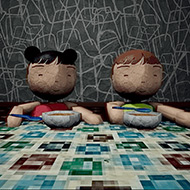
The presentation reinforces the conceit rather than just decorating it. Pepper the Giant Purple Dog mixes live-action footage, 2D illustration, and in-game 3D graphics, all filtered through a VHS-tape aesthetic — tracking lines, degraded color, the visual language of something recorded over and rediscovered rather than freshly rendered. Reviewers have specifically pointed to this mixed presentation as one of the demo’s most distinctive choices, since few mascot horror games commit to blending that many visual formats into one continuous experience.
What This Framing Buys Pepper the Giant Purple Dog
A straightforward horror game about a giant purple dog with an unstable hunger mechanic would still be unsettling on its own. Wrapping it in Jacob’s investigation and a fake production history adds a second layer of dread — not just “is Pepper dangerous,” but “why was this buried, and why did someone dig it up.” That question is left open in the demo, which is part of why the found-footage structure has become one of the most talked-about elements of the game so far.
- Is Jacob Collins a silent protagonist, or does he actually talk? Jacob is an active, voiced presence in the framing story rather than a silent stand-in — his investigation and reactions are part of what you’re following, not just a name attached to your viewpoint.
- Does the VHS filter ever go away during gameplay? The tape aesthetic is consistent with the game’s presentation throughout the demo, reinforcing the “recovered recording” idea rather than being reserved for cutscenes alone.
- Is the 2002 release date meant to be taken literally? No — it’s fictional scene-setting for the found-media premise, not a real claim about when development happened.
Strip away Jacob Collins, the VHS filter, and the fake 2002 backstory, and Pepper the Giant Purple Dog is still a tense pet-care horror game underneath. But that framing is doing real work — it’s the reason the demo feels like you’ve stumbled onto something rather than simply booted up another horror release.