













Five Nights At Freddys 3














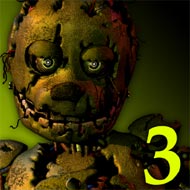
You are working security at Fazbear’s Fright, a horror attraction built around the legend of a haunted pizzeria, and the one animatronic actually moving through the vents is not a prop at all. Five Nights At Freddys 3 strips the cast down to a single real threat, Springtrap, while surrounding the night shift with hallucinatory Phantom animatronics designed purely to unsettle rather than kill.
Springtrap and the Single-Threat Design of Five Nights At Freddys 3
Where earlier entries in the series juggled multiple animatronics with distinct movement patterns, Five Nights At Freddys 3 commits to one real antagonist. Springtrap moves slowly and deliberately through Fazbear’s Fright’s camera network, which sounds like it should make him easier to track than a full cast, except the game compensates by making the tools you use to redirect him fallible on purpose.
Audio-lures are the primary defense: playing a sound in a specific room pulls Springtrap toward it, away from the office, but the system glitches convincingly enough that a lure can fail or play in the wrong room entirely if maintenance is neglected.
The Phantom Animatronics That Cannot Actually Kill You
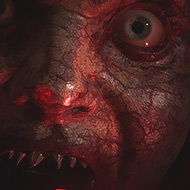
Phantom Freddy, Phantom Chica, Phantom Foxy, Phantom Balloon Boy, and Phantom Mangle appear throughout a shift, and none of them end a game outright the way Springtrap can. Instead, encountering one, catching Phantom Foxy in a hallway camera or Phantom Freddy standing in the office itself, forces a temporary system error that spikes noise and briefly cripples camera and ventilation controls at the worst possible moment.
What beginners get wrong in Five Nights At Freddys 3
New players often panic at a Phantom animatronic jumpscare the same way they would at a real threat, wasting the brief window afterward instead of immediately checking whether Springtrap took advantage of the system glitch to close distance. Recognizing that Phantoms are a distraction mechanic rather than a lethal one is one of the fastest ways to stop losing runs to panic alone.
Managing Ventilation and System Failures in Five Nights At Freddys 3
Five Nights At Freddys 3 layers a maintenance system on top of the usual camera-and-door loop: audio, video, and ventilation all degrade over a shift and need active repair, and letting ventilation fail for too long causes hallucinations to spike independently of anything Springtrap is doing. Balancing which system to repair first, rather than letting all three degrade while fixated on tracking Springtrap, is the actual skill the later nights demand.
- Audio-lure placement: redirecting Springtrap works, but the system can glitch and fail under pressure.
- Ventilation priority: letting air systems fail increases Phantom activity independent of Springtrap’s position.
- Camera discipline: tracking Springtrap’s last known position matters more than constantly flipping through every camera.
Advanced techniques Five Nights At Freddys 3 players miss
Experienced players repair ventilation reactively rather than on a fixed schedule, prioritizing whichever system is closest to full failure instead of cycling through all three evenly, since an unattended ventilation system causes disproportionately more Phantom interference than a slightly neglected camera feed.
The Minigames Behind Springtrap’s Story
Between nights, brief retro-styled minigames reveal fragments of the backstory tying Springtrap to the pizzeria’s darker history, including the events fans commonly refer to as the Bite of ’87. These sequences are optional in the sense that skipping them does not block progress, but they are where most of Five Nights At Freddys 3’s actual narrative lives, since the main night-shift gameplay offers almost no direct exposition on its own.
Frequently Asked Questions About Five Nights At Freddys 3
Players new to the series often ask why Springtrap moves so differently from animatronics in earlier games, and the answer ties directly into the story fragments from the minigames, which frame him as a fundamentally different kind of threat rather than just a reskinned mechanic. Another frequent question is whether the Phantom animatronics are worth worrying about at all: they cannot end a run directly, but ignoring the system chaos they cause is exactly how careless players let Springtrap close in unnoticed.
Between a single deliberate threat in Springtrap, a cast of Phantom animatronics built to distract rather than kill, and a maintenance system that punishes tunnel vision, Five Nights At Freddys 3 trades the earlier games’ chaos of tracking multiple characters for a tighter, more psychological kind of pressure that still holds up as one of the series’ tensest night shifts.
Comments
There are no reviews yet. Be the first one to write one.