









Universe Sandbox 2








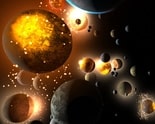
You drag Mars into Earth’s orbit, nudge the timeline forward, and watch two planets tear each other apart in real gravitational physics rather than a scripted animation. Universe Sandbox 2 is built entirely around that kind of experimentation, a physics simulator where stars, planets, and moons follow actual N-body gravity calculations instead of pre-baked orbital paths.
Real Gravity Instead of Scripted Orbits
The defining feature of Universe Sandbox 2 is that nothing is faked for effect. Every orbit, every collision, and every gravitational pull between bodies runs on the same physics whether you are watching two stars orbit each other or nudging a moon just close enough to a planet to see its tidal forces start pulling the surface apart. That commitment to simulation over spectacle is what separates it from a simple space-themed animation tool.
Time controls let players speed up or slow down a simulation to actually watch these physics play out at a readable pace, since real orbital mechanics on a planetary scale would otherwise take longer than any session could reasonably show.
Building and Breaking Solar Systems
Universe Sandbox 2 lets players start from scratch, placing stars and planets manually and watching whether the resulting system is even gravitationally stable, or load a recognizable solar system layout and start removing pieces to see what happens. Removing the Sun entirely and watching the outer planets drift into interstellar darkness is one of the most commonly shared scenarios among players precisely because the consequences play out with real orbital mechanics rather than a scripted collapse.
What beginners get wrong in Universe Sandbox 2
New players often place bodies too close together expecting a stable system by default, then are surprised when gravity pulls everything into a chaotic collision within a few simulated years. Building a stable system in Universe Sandbox 2 takes actually respecting orbital velocity and distance, not just placing planets wherever looks visually balanced.
Collisions, Climate, and Terraforming Tools
Beyond gravity, Universe Sandbox 2 models surface-level detail too: atmosphere composition, surface temperature, and water coverage all respond to changes a player makes, whether that is moving a planet closer to its star or altering its atmosphere directly with the terraforming tools. Turning a barren rock into something with liquid water, or pushing a habitable planet close enough to its star to boil its oceans away, are both well within what the simulation actually tracks rather than just displaying cosmetically.
- Collision merging: two bodies colliding at survivable velocities can merge rather than simply destroying one another.
- Tidal forces: a moon or planet passing too close to a larger body visibly deforms and can break apart.
- Climate sliders: atmosphere and distance-from-star adjustments directly change surface temperature and ice coverage.
Advanced techniques Universe Sandbox 2 players miss
Experienced users build custom systems with deliberately calculated orbital velocities rather than relying on preset scenarios, and cross-referencing real orbital distances before placing a body saves a lot of trial and error compared to nudging planets around until something looks stable by eye.
Black Holes and the Scenarios Players Keep Coming Back To
Once a black hole enters a scenario, Universe Sandbox 2 shifts from planetary-scale experimentation into something closer to an actual astrophysics demonstration, with accretion effects and gravitational lensing giving a visual sense of just how violently spacetime bends near one. Community-shared scenarios built around black holes consuming entire star systems remain some of the most viewed content built with the simulator.
Frequently Asked Questions About Universe Sandbox 2
Do I need a science background to use Universe Sandbox 2?
No, the interface is built for experimentation without requiring prior astrophysics knowledge, though players with some background in orbital mechanics tend to build more deliberately stable systems faster than those relying on trial and error.
Can two planets actually survive a collision in Universe Sandbox 2?
Yes, depending on relative mass and velocity, a collision can result in a merged body rather than total destruction, which is part of why so many shared scenarios revolve around testing exactly where that threshold sits.
Whether the appeal is quietly building a stable multi-planet system or gleefully throwing Mars into Earth’s path just to watch the aftermath, Universe Sandbox 2 turns real astrophysics into something players can poke at directly, and that hands-on curiosity is exactly what keeps its community sharing new scenarios years after first discovering what happens when you remove the Sun.
Comments
There are no reviews yet. Be the first one to write one.